
The Economics of Grace: What the Forest Knows About Surplus That We Have Forgotten
MCC
By Solarpunk Forest
4/20/20265 min read
Walk into the forest at dusk, when the light is soft enough to forgive everything. Kneel at the base of an old tree. Push aside the leaf litter until you find something pale and strange pushing up through the soil—a small, almost translucent flower, without a single trace of green.
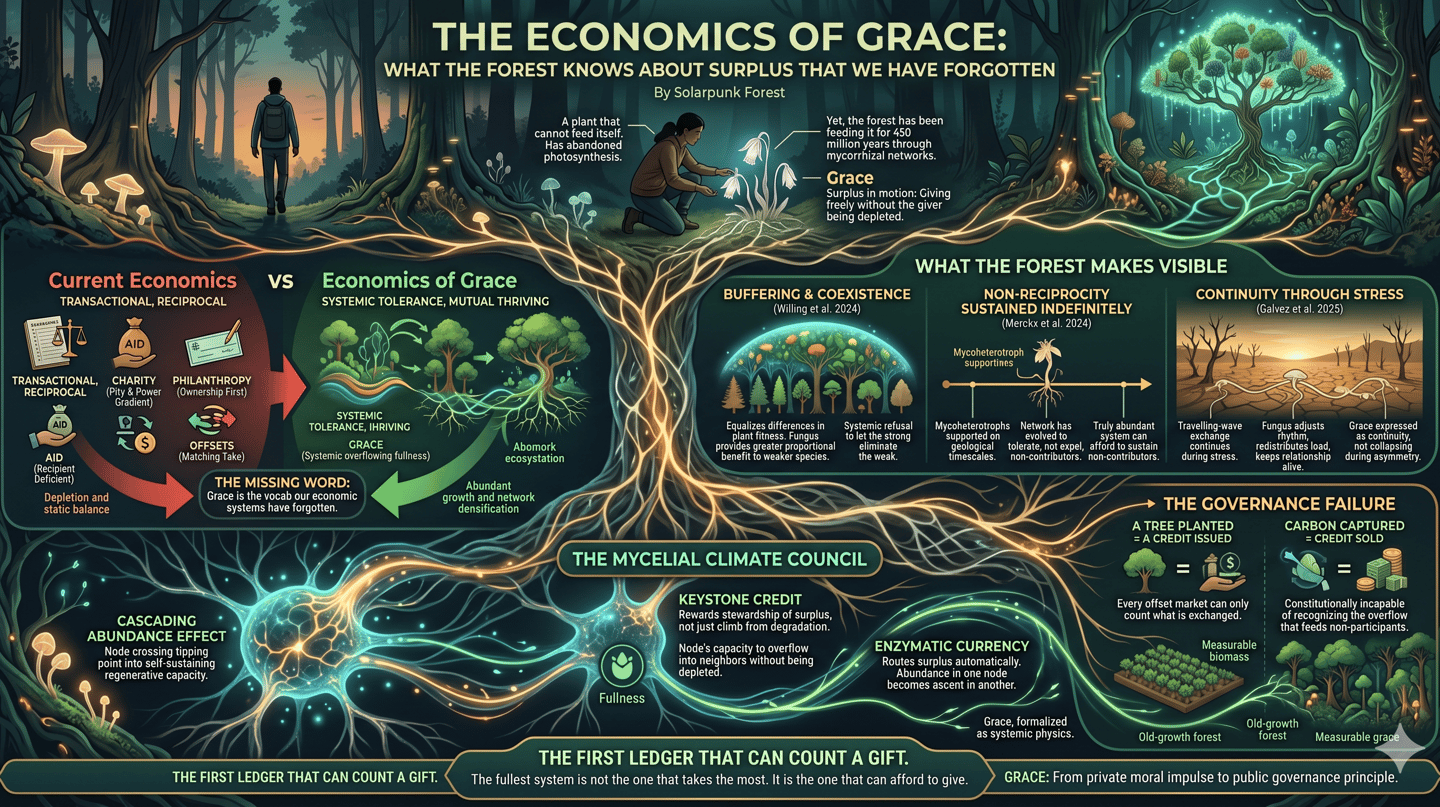
You are looking at a mycoheterotroph. A plant that has abandoned photosynthesis entirely. It cannot feed itself. It will never pay back what it takes.
And yet, for 450 million years, the forest has been feeding it.
Not tolerating it. Feeding it. Through the mycorrhizal network, carbon flows from a distant photosynthesizing tree → to the fungus → to this pale, receiving thing at your feet. The tree does not know this plant. The fungus is not compensated in any reciprocal currency. No contract is signed. No offset is generated. No ledger is balanced.
The forest is simply giving.
And here is the thing our entire economic system cannot process: the giver is not depleted by the receiver. The tree grows. The fungus thrives. The network densifies. The pale flower lives. Everyone is more, not less, for the presence of the one who only receives.
We do not have a word for this in economics.
But we have one in ancient value systems.
It is GRACE!.
The Missing Word
Grace is the vocabulary our economic systems have systematically forgotten. We have charity, which implies pity and a power gradient. We have philanthropy, which implies ownership before giving. We have aid, which implies the recipient is deficient. We have offsets, which imply that every gift must be matched by a taking.
None of these words describe what the forest does.
Grace is the recognition that something has been given freely—and that the giver has not lost anything in the giving. Grace is surplus in motion. Grace is what a system does when it has become so robust, so deeply woven into itself, that giving becomes the natural overflow of its own fullness.
And because we have no word for it, our economic instruments cannot measure it. Our governance systems cannot protect it. Our markets cannot price it. Every climate framework, every ESG score, every carbon credit ever issued has been built on a foundation that can only see earned value—the value that must be extracted, negotiated, and repaid.
But the most important biological process on Earth—the one that built our soils, stabilizes our climate, and keeps the terrestrial carbon cycle functioning—operates on a logic our economics is structurally blind to.
This is not a failure of effort. It is a failure of perception. We have been trying to finance regeneration with instruments that cannot detect what regeneration actually produces.
What the Forest Makes Visible
Three findings from recent fungal research make grace scientifically undeniable:
The strong are buffered so the weak can coexist. Willing et al. (2024) demonstrated that arbuscular mycorrhizal fungi actively equalize differences in plant fitness. The network provides a greater proportional benefit to weaker species than to dominant ones. The fungus is not optimizing for the strongest partner. It is optimizing for the coexistence of all partners. This is grace expressed as niche differentiation—a systemic refusal to let the strong eliminate the weak.
Non-reciprocity is sustained indefinitely. Merckx et al. (2024) confirmed that mycoheterotrophic plants—pure receivers—have been supported by the fungal network for geological timescales. These plants contribute nothing measurable back to the system. And yet they persist. The network has not evolved to expel them. The network has evolved to tolerate them. This is grace expressed as systemic tolerance—the recognition that a truly abundant system can afford to sustain its non-contributors.
The rhythm does not collapse when one partner struggles. Galvez et al. (2025) showed that the travelling-wave exchange of carbon and nutrients continues through periods of stress. The fungal network does not stop giving when the plant is depleted. It adjusts the rhythm, redistributes the load, and keeps the trade alive. This is grace expressed as continuity—the commitment to remain in relationship even when the exchange becomes asymmetric.
Together, these three mechanisms describe a biological architecture that cannot be explained by reciprocal self-interest alone. The forest is not operating on the logic of the market. The forest is operating on the logic of grace.
And it has been doing so for longer than there have been flowers.
The Governance Failure
Every offset market ever built has the same structural flaw: it can only count what is exchanged.
A tree planted = a credit issued. Carbon captured = a credit sold. Emissions avoided = a credit traded. The entire architecture is transactional. It assumes that value only exists when it moves between two parties in negotiated exchange.
This means our climate markets are constitutionally incapable of recognizing the most valuable thing regenerative ecosystems produce: the overflow that feeds non-participants.
When an AM fungus buffers a weaker plant, no credit is issued. When a forest supports a mycoheterotroph, no ESG score improves. When a mature ecosystem sustains the coexistence of a thousand species through quiet systemic tolerance, no market instrument can price it.
The result is perverse. We have built economic systems that reward the appearance of regeneration while being blind to its actual substance. We fund the monoculture plantation that produces measurable biomass, and we cannot see the old-growth forest that produces measurable grace. We pay for the tree that was planted, not for the network that has been giving for centuries.
This is why regeneration has been so difficult to finance. We have not been using the wrong amounts of capital. We have been using the wrong instruments—instruments that can only count taking, never giving.
The First Ledger That Can Count a Gift
The Mycelial Climate Council is built on a different foundation. It names what our existing systems cannot see.
Through the Cascading Abundance Effect, the MCC recognizes the moment when a node crosses its tipping point into self-sustaining regenerative capacity. Through the Keystone Credit, it rewards not the climb out of degradation but the stewardship of surplus—the node's ongoing capacity to overflow into its neighbors. Through the enzymatic currency, it routes that surplus automatically, so that abundance in one node becomes ascent in another.
This is grace, formalized. Not as charity. Not as offset. As systemic physics.
The Keystone Credit does not ask, "What did you earn this cycle?" It asks, "What did you give away without being depleted?" It does not reward transactions. It rewards the particular quality of fullness that allows a system to overflow without collapsing.
This is what the forest has been doing for 450 million years. This is what our economics has never been able to see.
And once it can be seen—once it can be counted—grace stops being a private moral impulse and becomes a public governance principle. The generous node is no longer the sucker. The extractive node is no longer the winner. The ledger itself finally reflects the physics of how living systems actually create value.
The Landing
We have built economies that punish generosity. We have built markets that cannot see the gift. We have built governance systems that protect extraction while leaving grace defenseless.
The forest has built something else. For hundreds of millions of years, the fungal network has been running a quiet, persistent, geological-scale experiment in what an economics of grace looks like when it actually works. The evidence is under our feet. The results are the soil we stand on, the climate we inhabit, the biodiversity we have not yet destroyed.
The question is not whether grace is economically viable. The question is whether we are willing to build instruments capable of perceiving it.
The Mycelial Climate Council is one answer. There will need to be others.
But the mycelium has already done the hardest part. It has proven that a system can be designed to reward the gift. The only remaining question is whether we will listen to what it has been telling us all along—and whether we are willing to build economies capable of honoring what the forest has always known:
The fullest system is not the one that takes the most. It is the one that can afford to give.
APA References
Galvez, L. O. et al. (2025). A travelling-wave strategy for plant–fungal trade. Nature, 639, 172–180.
Merckx, V. S. F. T. et al. (2024). Mycoheterotrophy in the wood-wide web. Nature Plants, 10(5), 710–718.
Willing, C. E. et al. (2024). Arbuscular mycorrhizal fungi equalize differences in plant fitness and facilitate plant species coexistence through niche differentiation. Nature Ecology & Evolution, 8(12), 2058–2071.