
The Ghost in the Cell:
Unlocking the Ancient Mystery of Arbuscular Mycorrhiza
MCC
12/8/20252 min read
We live in a world obsessed with walls. Borders, firewalls, property lines, skin. We define ourselves by where we end and where the "other" begins.
But beneath our feet, in the silent dark of the rhizosphere, a 450-million-year-old ritual challenges the very concept of separation. It is the story of the Arbuscular Mycorrhiza (AM)—the fungus that learned how to walk through walls not to conquer, but to commune.
This is not just symbiosis. This is biological non-duality.
The Fractal Mirror: As Above, So Below
The mystics have always said, "As above, so below." The Arbuscule is the physical proof of this law.
Above ground: The plant reaches its branches up to the sun to catch light (Carbon).
Below ground: The fungus reaches its filaments into the soil to catch minerals (Phosphorus/Nitrogen).
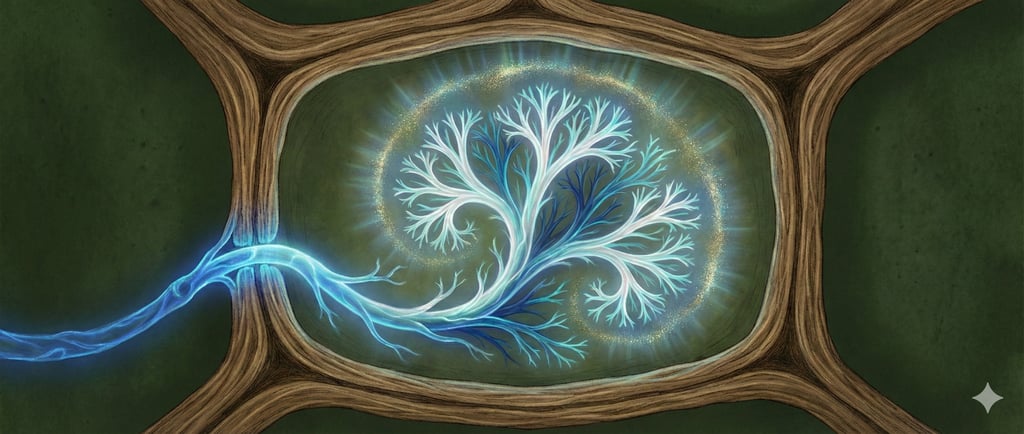
Inside the cell: The fungus creates a micro-tree (the Arbuscule) that mirrors the tree above.
At this interface, the membrane of the fungus and the membrane of the plant press against each other, separated by a space smaller than a thought. Here, the great alchemical trade occurs. The plant offers liquid sunlight (sugar/lipids). The fungus offers distilled earth (nutrients).
It is a Communion in the truest sense. The body of the earth becomes the body of the plant.
The Sacred Invasion
Most relationships in nature are external. The bee lands on the flower. The bird nests in the tree. But AM fungi do something radical. When an AM fungal hypha meets a plant root, it doesn't stop at the surface. It dissolves the cell wall—the plant’s primary defense—and pushes inside.
In any other context, this would be an infection. A declaration of war. But the plant does not fight. Instead, it guides the fungus deeper. It opens the gates to its inner sanctum. Inside the plant's cortical cell, the fungus performs a miracle of architecture. It branches out, dividing and subdividing until it forms a delicate, tree-like structure called an Arbuscule (from the Latin arbusculum, "little tree").
Look closely at this "Little Tree." This is where the magic happens.
The "Peri-Arbuscular" Space: The Zone of Trust
Science calls the thin fluid layer between the fungus and the plant cytoplasm the Peri-Arbuscular Interface. I call it the Zone of Radical Trust.
For this system to work, the plant must lower its immune system. It must allow an "alien" entity to inhabit its own living tissue. If the plant doubts, the connection breaks. If the fungus becomes greedy, the plant dissolves the Arbuscule (a process called digestion).
It is a relationship maintained moment-by-moment through a continuous exchange of signals. "Are you still serving the whole?" "Yes." "Then you may stay."
The "Inner Net" vs. The Internet
We marvel at our digital "Cloud," a network of wires and servers connecting us externally. But the AM Fungi are the Intracellular Network. They link plant to plant, not just by touching roots, but by threading through the very cells of the forest.
When we till the soil, when we flood the ground with synthetic fertilizers, we are not just adding chemicals. We are shattering these Arbuscules. We are exorcising the "ghost" from the machine. We are leaving the plants alone, disconnected, trapped behind their own walls, deaf to the wisdom of the soil.
The Return to the Sanctum
To restore our climate, our agriculture, and our sanity, we must understand the lesson of the Arbuscule: Life does not happen in isolation. It happens in the penetration of boundaries.
We need to stop farming "plants" and start farming symbioses. We need to design systems that protect this delicate, intracellular architecture.
Because in the end, we are all just membranes waiting to be crossed. We are all waiting for that connection that proves we are not alone in the dark.