Stored Carbon Increment: measuring what a forest adds each year
The Stored Carbon Increment (SCI) methodology measures how much carbon a forest actually takes from the atmosphere each year and stores in its trees and roots. Every service token is based on that measured increment, never on projections.
Why measure the increment
Many carbon accounting systems try to estimate what might have been lost without a project: a speculative baseline that is hard to check and easy to inflate. That approach has produced credits for carbon that was never really removed.
SCI asks a simpler question: how much more carbon does this forest hold this year than last year? It measures what the forest has actually accomplished, as carbon stored in living biomass.
Because it is measured every year, SCI also works as the forest's vital signs. High increments show a healthy, growing forest. A decline signals stress or maturation and triggers investigation and adaptive management.
From a tree to a token, step by step
Each step uses published, peer-reviewed science, adapted to the forest's species and geographical context.
-
Step 1
Measure every tree
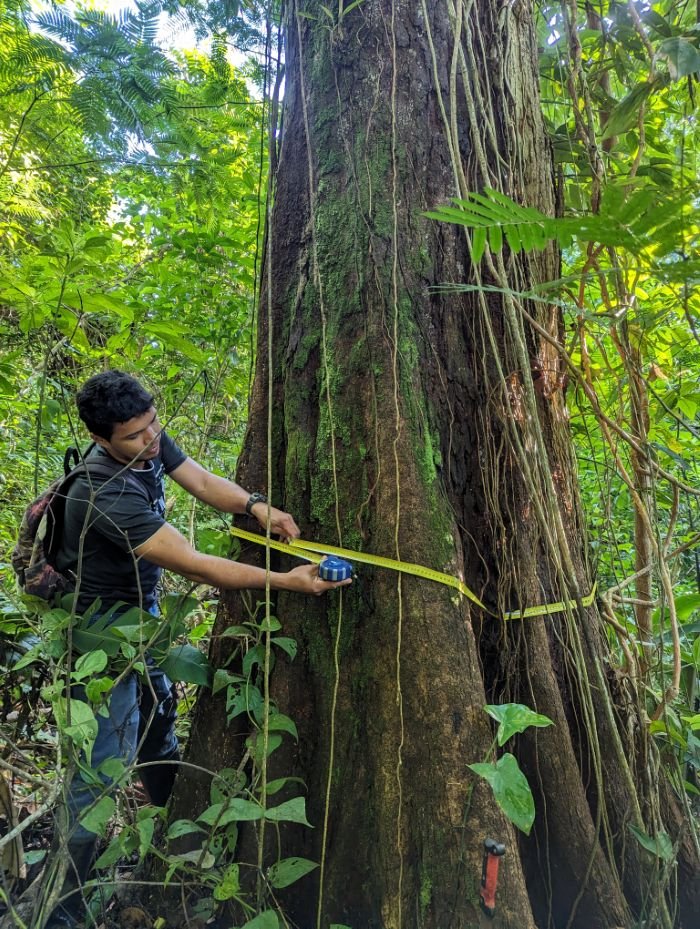
In a permanent research plot, every tree is identified by species and measured without harming it: circumference at breast height (1.3 m), from which diameter is calculated, and height. Measurements are repeated so each tree's growth can be followed over time.
-
Step 2
Calculate the biomass above ground
Biomass is calculated with an allometric equation: a published formula that relates a tree's wood density, diameter and height to its biomass. In its general form:
AGB = a × (ρ × DBH² × H)b
AGB is the biomass above ground, ρ the wood density, DBH the diameter at breast height and H the tree's height. The coefficients a and b are not universal: scientists derive them for each forest type from trees that were measured and weighed, so a tropical rainforest, a dry forest and a temperate forest each use their own equation. For Solarpunk Forest, a tropical rainforest, we use the pantropical model of Chave et al. (2014).
Species grow in different ways, so each species is assigned a growth factor: fast pioneers such as Cecropia obtusifolia 1.10, secondary-forest species such as Pentaclethra macroloba 0.95, slow climax hardwoods such as Carapa guianensis 0.85. Where height is hard to measure under a dense canopy, it is estimated in three complementary ways: functional-group growth rates, a general height–diameter model (Feldpausch et al. 2011), and a height–diameter model fitted to this forest's own data.
-
Step 3
Add the roots
Roots below ground are added at 18.6% of the biomass above ground, a root-to-shoot ratio chosen for tropical secondary forests instead of the generic tropical range of 20–30%.
-
Step 4
Cross-check with a second method
Total biomass is also estimated with the biomass expansion factor of 1.24 recommended by the IPCC (2006) for moist tropical forests. Comparing both methods reveals measurement errors and keeps the estimate honest.
-
Step 5
Convert biomass to carbon, and carbon to CO2
About 47% of dry wood is carbon (Thomas & Martin 2012; the IPCC default). Each tonne of carbon stored means 44/12, or about 3.67, tonnes of CO2 removed from the atmosphere.
-
Step 6
Calculate the increment and scale to the forest
The Stored Carbon Increment is the difference between one year's total and the next. Results from the research plot are extrapolated to the whole forest, taking into account that dense secondary forest and open transition areas store carbon at different rates.
-
Step 7
Issue the year's tokens
Once a year, service tokens are minted on the forest's NFT for the verified increment: one token per tonne of CO2 removed that year. The data behind each issue is recorded on the blockchain, so it cannot be changed afterwards.
From field measurements to real-time data
First result: more than 30 tonnes of CO2 per hectare per year, measured on the representative research hectare in 2023. The figure is preliminary: the methodology is currently being reviewed and updated.
The method starts with careful manual fieldwork. In October and November 2023, every tree in Solarpunk Forest's one-hectare permanent research plot was inventoried and measured, and the plot has since been remeasured to calculate the first increments.
The next phase adds sensors in the forest for continuous, real-time monitoring, always calibrated against the manual measurements:
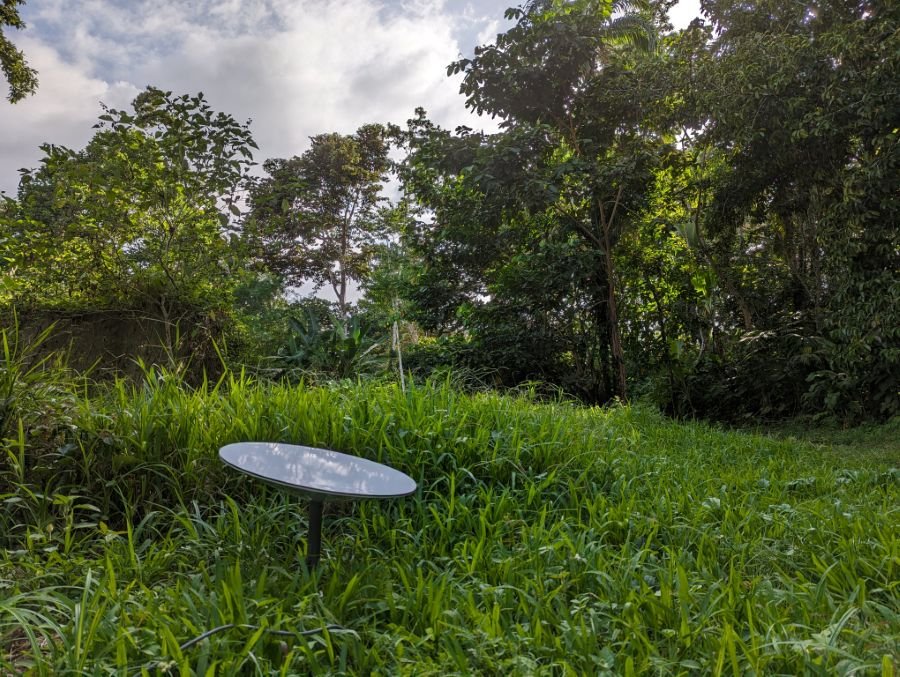
- Prototype, being deployed now: three custom-built dendrometers that record trunk growth with sub-millimetre precision, at a fraction of the cost of commercial instruments. They send their data over a low-power LoRaWAN network with a Starlink satellite uplink, and are being installed in Solarpunk Forest and in a test forest in Romania.
- Planned: environmental and soil carbon flux sensors that capture the conditions behind growth and the carbon the soil releases, and more dendrometers across the forest.
- Planned: drone and satellite data to monitor the whole forest, and new forests, at landscape scale.
Built to work in any forest
The steps stay the same everywhere; the equations change with the forest. The methodology includes allometric approaches for tropical rainforests, tropical dry forests, temperate, boreal, montane, mangrove and Mediterranean forests.
The next extension of the pilot is aimed at a temperate forest in Romania from 2027, where the same steps will be applied with allometric equations for temperate species.
Measurement protocols and sensor designs are documented openly, so research institutions and forest communities elsewhere can replicate them.
Key scientific sources
- Chave, J. et al. (2014). Improved allometric models to estimate the aboveground biomass of tropical trees. Global Change Biology, 20, 3177–3190.
- Feldpausch, T. R. et al. (2011). Height-diameter allometry of tropical forest trees. Biogeosciences, 8, 1081–1106.
- IPCC (2006). Guidelines for National Greenhouse Gas Inventories, Volume 4: Agriculture, Forestry and Other Land Use.
- Thomas, S. C. & Martin, A. R. (2012). Carbon content of tree tissues: a synthesis. Forests, 3, 332–352.
- Clark, D. A. & Clark, D. B. (2001). Getting to the canopy: tree height growth in a neotropical rain forest. Ecology, 82, 1460–1472.
- Poorter, L. et al. (2015). Diversity enhances carbon storage in tropical forests. Global Ecology and Biogeography, 24, 1314–1328.
The methodology is currently being reviewed and updated. For independent scientific review, we are in discussions with universities in Romania and Costa Rica about including it in a research grant.