How a forest earns from the work it already does

Today the value of a forest is narrowly defined by the commercial worth of its timber. That limited view leads to deforestation and ignores almost everything a forest does for the economy. Our model makes the rest visible, measurable and payable.

The three steps

Give the forest a digital identity

Each forest receives a unique digital identity in the form of an NFT: a digital passport that records what makes that forest unique.

Imagine a forest that can represent itself in the digital world, where every tree has a record, a presence, a voice. With a digital identity, forests are no longer silent bystanders but active participants in economic systems. Their ecological services, like carbon capture, biodiversity and climate regulation, can be recognised, measured and valued.

At the foundation is blockchain technology, which is transparent, secure and immutable. It acts as a digital passport for forests, ensuring the authenticity of ecological data and enabling participation in global markets.

The NFT is the forest's identity, not a product. It stays in the possession of the forest's owner. What the forest offers to the market are its services, in step 2.

Solarpunk Forest in Costa Rica holds the first identity: token ID 1.
Measure its services and mint tokens

Every token stands for a service the forest has been measured to provide. We start with the one the economy already knows how to price: the carbon a forest stores.

For carbon, we use our Stored Carbon Increment (SCI) methodology. Instead of estimating what a forest might have lost without protection, SCI measures what it actually adds each year: the extra carbon stored in its trees and roots compared with the year before. It is built on peer-reviewed allometric equations, adapted to the forest's species and geographical context. Read the SCI methodology

Once a year, the verified increment is minted as tokens on the forest's NFT. Each token represents one tonne of CO2 the forest removed from the atmosphere that year, so every token can be traced back to the forest that provided it and the data behind it.

Carbon is the starting point, not the limit. Forests also regulate water, protect biodiversity and pollinators, hold soil in place, mitigate floods and cool the climate around them. The same identity can carry each of these services as they become measurable.

Lease the forest's services

Think of it as Airbnb for forests: a company books the forest's capacity to store its emissions, pays the forest for that service, and receives tokens as the record.

Each token represents one tonne of CO2 that the company has stored in the forest. Tokens are not a tradeable asset: they are proof that the company paid the forest for a measured service. The NFT, and with it the forest's identity, stays with the forest's owner.

An online marketplace, where companies can lease forest services directly, is planned and not built yet. Until then, pilot leases are arranged by direct agreement.

Measuring what the forest does

Conservation in Solarpunk Forest goes beyond protection. It is a dynamic, data-driven process.

The Stored Carbon Increment (SCI) methodology. We don't invent new science. Trees in a permanent research plot are measured every year, and an allometric equation chosen for the forest type turns their diameter, height and wood density into biomass (for Solarpunk Forest, the pantropical model of Chave et al. 2014). Species-specific growth factors and root ratios adapt it to the forest's geographical context, and an IPCC cross-check keeps it honest. The methodology step by step

From field measurements to real-time data. The first increments come from careful manual measurements, made since October 2023. The next step is continuous, real-time monitoring: three custom-built dendrometers, which record trunk growth to a fraction of a millimetre and send their data over a LoRaWAN network with a Starlink uplink, are now being deployed in Solarpunk Forest and in a test forest in Romania. With them, the value behind each token can be followed over time instead of being estimated once. Why real-time data matters for carbon credits

Adaptive Ecosystem Intelligence (AEI), planned. Once sensor data flows continuously, AI analysis will reveal patterns that were previously invisible. That knowledge will guide targeted action, from restoring degraded areas and enhancing biodiversity corridors to reducing wildfire risk, so conservation becomes proactive instead of reactive.

The Forest API, planned. A technological bridge that will give organisations direct access to forest data: carbon sequestration estimates, biodiversity indices and water regulation services, to support sustainability reporting and compliance with the EU's Corporate Sustainability Reporting Directive (CSRD). Read about the Forest API

Where it stands: sensor network, prototype (three dendrometers being deployed); AEI and Forest API, planned.

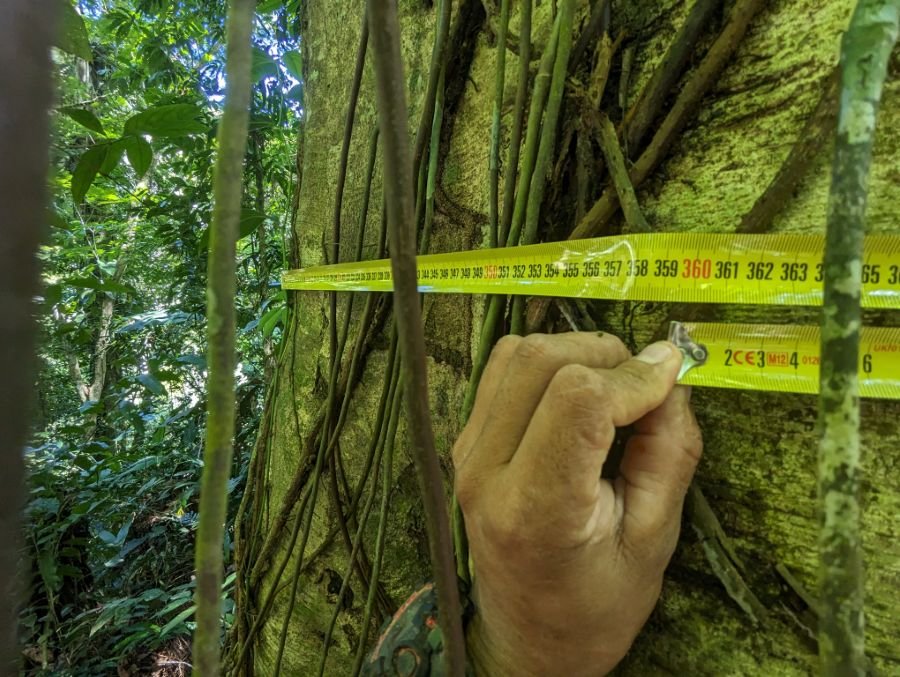
A hand holding a folding rule against a tree trunk to measure its diameter in the research plot.

Where the money goes

Forests finance their own survival.

The economic value of services like carbon sequestration and biodiversity is reinvested directly into the forest, creating a self-sustaining cycle. The funds pay for protective measures, advanced monitoring technology, and AI that can advocate for and represent the forest's interests more effectively.

Local communities take part too: they are paid for the conservation and stewardship work they do, with compensation drawn directly from the value of the ecosystems they help protect.

Most of the income goes back into the forest and its stewards. The exact split between the forest, local stewards and Solarpunk Enterprises will be set before the marketplace launches.

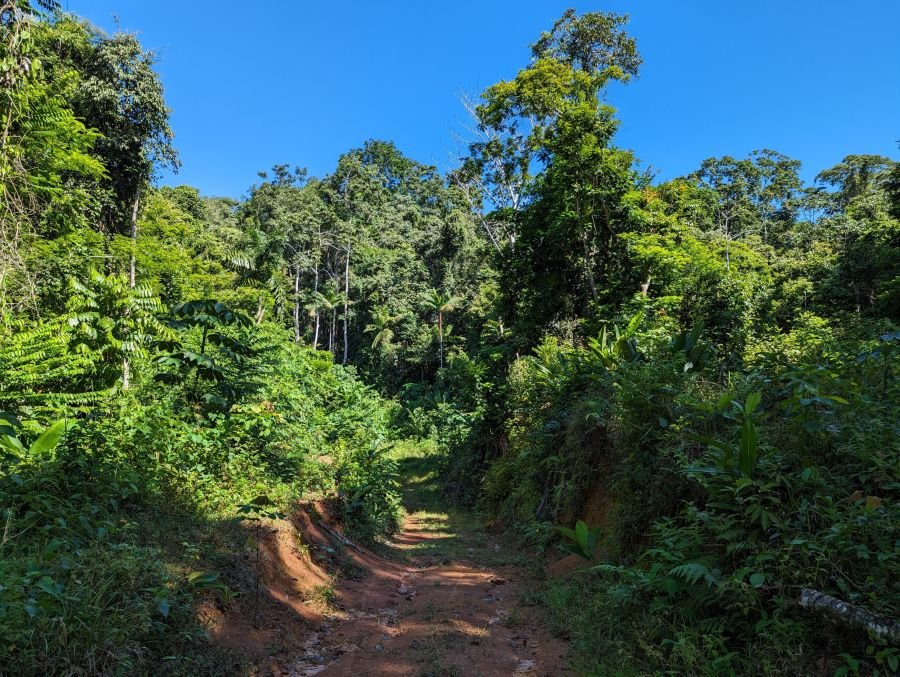
A dirt track leading into the rainforest under a blue sky.